
What it Takes to Get a Fairytale Exit
Multiples don’t happen by chance. They’re not spun from luck, magic, or even EBITDA alone.
Early-stage, mid-cycle, or gearing up for exit, one truth holds: the table must be set to impress. When it’s showtime, buyers don’t just measure what you’ve built—they bet on what they believe can grow.
Scalable growth? Absolutely.
Customer loyalty? Mission critical.
Brand strength? Non-negotiable.
Confidence isn’t created at the finish line. It’s built in every signal you send.
The Brandless Emperor
Invite Only. Don’t Come Just As You Are
Once upon a time, yes, EBITDA ruled the kingdom of valuation far and wide. If the numbers looked good, the deal looked good. But the story is shifting, and in today’s market, buyers aren’t just buying what’s been built—they’re investing in what they believe can scale.
That belief is shaped long before the LOI is signed and well before the data room opens. It’s formed by how clearly a company signals its market position, traction, credibility, and capacity to grow. When those signals are missing or misaligned, even the best-run companies can walk into diligence underdressed.
Branding and marketing strategies aren’t window dressing; they shape the fabric of perception and directly influence how investors calculate the multiple.
The data proves it:
- Buyout Multiples Are Slipping: According to McKinsey, buyout multiples have dropped by about 1× EBITDA. With less room for error, organic growth and brand strength are critical to protect IRR. McKinsey & Company, 2024
- Brand Equity Now Dominates Deal Value: Intangible assets, including brand, account for 90%+ of total deal value, especially in tech-enabled and service-based sectors. Jahani & Associates, 2025
- Brand Strength Influences Valuation. Academic research confirms that strong brands directly impact enterprise value—particularly in competitive or commoditized B2B industries. Brand equity can account for 20–30% of total deal value, and in some sectors, as much as 50%. The Valuation Impact of Branding and Market Positioning in M&A Deals
- Buyers Want Differentiation, Not Duplication: Bain reports firms with strong GTM strategy and clear positioning command higher multiples and buyer confidence, especially in markets that require share capture. Bain & Company, 2023
- Brand Misalignment Reduces Value. PE deal teams estimate that brand fragmentation and marketing gaps can reduce perceived enterprise value by 5–15% during diligence. Journal of Brand Management, 2013
The moral of the story? Financials may open the doors, but they won’t hide the truth. At exit, every company steps into the light and the brandless emperor is always exposed. In a market where confidence creates premiums, brand is no longer decoration. It’s the robe your business wears into the room. And it had better fit.
The X Factor Driving the Multiple
A Hero Emerges
Call it a plot twist if you want, but this is where the story deepens. This is where marketing enters the equation, not as a department, but as the X factor: a composite force of brand, marketing, and sales enablement.
For simplicity, we’ll call it marketing. But don’t confuse simple with small. It doesn’t show up neatly in your model; it’s often buried, mislabeled, or written off as overhead. Yet its impact is undeniable—on positioning, pricing power, sales velocity, and brand perception. And in private equity, perception is the premium.
When factoring growth, you can’t use standard equations—or worse, Common Core math. You need marketing math: faster, louder, harder to quantify, but impossible to ignore. It’s not the strong, silent type. Then again, neither are PE multiples.
Just like PE firms stretch and normalize EBITDA to make the numbers sing, strategic marketing flexes brand impact to drive real outcomes, turning fragmented signals into scalable systems. Built in early and aligned to revenue, marketing doesn’t just support the multiple. It expands it.
The Trouble With The X-Factor
The Cinderella Variable: It’s an Underweighted Constant
In the calculus of value creation, there’s an underweighted constant—a Cinderella variable. Strong, ever-present, and quietly powerful, yet still misunderstood or left out of the equation until it’s almost too late. For all their influence, brand, marketing, and sales are often the first to be sidelined—brought in too late, exited too early, or worse, treated like tactical afterthoughts. These critical levers get dismissed, underfunded, and shut out of the boardroom while the so-called “real” drivers—finance, operations, and technology—take center stage.
But when value creation stalls, the invitation to the ball is suddenly granted. Brand must conjure differentiation. Marketing must accelerate demand, immediately. Sales enablement? Scaled overnight. Buyer confidence? Through the roof, please.
So, hold your breath and hope. Because now it’s bibbidi-bobbidi-boo time. The thingamabob that does the job? Apparently, that’s them too. Voilà—the overlooked trio is suddenly expected to deliver a three-point lift in valuation. No plan. No team. No budget. Just blind faith that it’ll all work out.
If wishes were strategy and business were a fairy tale, it might. But in the real world, ready or not, the clock always strikes midnight.
Get the X Factor Right
The Power of the Whole Equation
Exponential returns don’t come from fairy dust or luck—they come from focused strategy, strong systems, and alignment across every function. Marketing creates real enterprise value, but only when it’s brought in early, built to scale, and fully integrated with brand, sales, operations, finance, and the customer experience.
When those parts move together, the equation balances. What’s built is believed. What’s promised is delivered. And what’s delivered compounds into confidence, growth, and enterprise value.
That’s when marketing stops being a supporting act and becomes the X factor—exponentially transforming:
As multiples compress, hold periods shorten, and investor expectations rise, marketing has moved from “nice to have” to non-negotiable. It’s a critical lever for growth, margin expansion, and valuation—delivering:
In enterprises pursuing accelerated growth—whether through M&A, consolidation, or organic expansion—the exponential power of marketing’s X factor hinges on unity. When legacy brands align under one clear identity, confusion fades, equity strengthens, and the story presented to both the market and future buyers becomes sharper, stronger, and more premium.
Because when every part of the equation moves in sync—brand, sales, marketing, finance, and operations—the output multiplies. Unity doesn’t just streamline perception; it compounds confidence, amplifies margin, and sets the stage for premium valuation.
Once Upon a Multiple
What to Watch (and What Works) on the Road to Exit
Every exit tells a story. Some are masterpieces of opulence and design—crafted with precision and intention, presented to investors like a Fabergé egg: rare, gleaming, and built to impress. Others are cautionary tales of detours and breakdowns that strip away value, erode confidence, and expose the cracks beneath the polish. From value-building plays to near-misses, these real-world examples reveal what to watch—and what works—at every stage of the growth-to-exit journey.
Early Stage
How Brand Chaos Eroded Margins
- The who: A PE-backed portfolio company rushed to scale without aligning acquired brands.
- The challenge: Two sister companies—same parent, different brands—unknowingly submitted proposals to the same prospect.
- The impact: The lower-priced brand won, undercutting its sister and leaving $780K in annual revenue on the table. Pricing power and credibility eroded.
- The takeaway: Align GTM early. Deal discipline and brand governance prevent internal competition and protect margin.
- How to get it right: Unify brands unless geographic equity is clear. Set “one company, one bid” rules. Centralize brand governance. Share pipeline visibility and set pricing guardrails with clear ownership protocols.
Mid‑Cycle
How Strategic Messaging Won in a Volatile Market
- The who: An international services firm faced rising costs and razor‑thin margins.
- The challenge: Implement broad price increases without triggering churn.
- The impact: A coordinated value campaign enabled a price uplift across key markets, generating $3.2M in new annual revenue with minimal churn.
- The takeaway: Messaging isn’t a soft skill. It’s a margin lever. When executed across teams, it equips everyone to lead with value not urgency.
- The right move: Launch internal enablement (talk tracks, FAQs, objection handling) alongside staged customer messaging by region and segment.
Pre‑Exit
When the Playbook Changed, the Multiple Dived
- The who: A national, PE-backed services firm that pivoted strategy in Year 4 of a five-year hold—just as exit prep was beginning.
- The challenge: Leadership pulled back on marketing and repurposed the sales team, betting that early momentum would carry them through the exit.
- The impact: The market shifted. Momentum stalled. Valuation fell by 1.5x and the company exited below target.
- The takeaway: Don’t bench your GTM engine before the final whistle. Sustainable momentum requires offense and defense, working in sync until the end.
- How to get it right: Keep positioning and demand gen active. Run quarterly “exit-readiness” sprints. Monitor pipeline, win rates, and retention across functions. Stay agile. Stay aligned.
What these stories share isn’t just hindsight, it’s pattern recognition. Companies that outperformed don’t wait for the market to define their value; they build it, protect it, and prove it at every stage. When brand, marketing, and sales stay in motion together, value compounds. And when they drift apart? Even the strongest story loses its multiple.
The Alchemy of Alignment
Turning Strategy Into Gold
In every fairytale, there’s a moment when something ordinary turns to gold. In business, that transformation doesn’t come from magic, it comes from alignment. True alchemy happens when every function moves in concert: operations delivering on promise, finance reporting performance, sales driving sustainable growth, and client success sustaining belief.
Strategic marketing delivers that alignment across every function; translating operations, finance, sales, and client success into one coherent narrative of performance and potential. It’s the bullhorn and the compass, amplifying what’s working and steering what’s next. When done right, it distills complexity into a clear, investor-ready story that signals growth, confidence, and control.
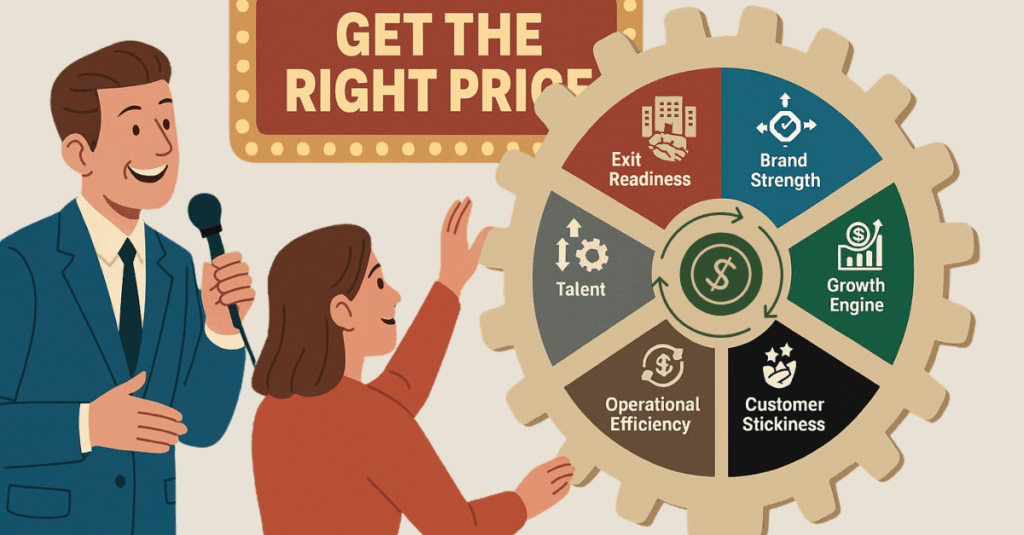
That story—and its value—is built through:
- Message Discipline: Can your team clearly explain who your personas are, what you do, and why you win? Without it, your story fractures—mixed messages erode confidence before the numbers are even seen.
- Scale Readiness: Are your brand systems, tech stack, and GTM tools built to support post-close growth? Without it, momentum stalls and integration costs rise, slowing what should accelerate.
- Asset Integrity: Are your decks, websites, and collateral current, compelling, and investor-grade? Without it, credibility falters—the proof points investors seek go missing.
- Talent Alignment: Do your internal teams understand the story and feel equipped to tell it consistently across every touchpoint? Without it, even the best strategy falls flat—execution loses conviction and cohesion.
- Customer Endurance: Are your relationships strong enough to withstand change—and loyal enough to grow with you post-transaction? Without it, the base you’ve built may not follow when ownership or direction shifts.
Behind every strong multiple is a story someone prepared ahead of time.
The only question is—will it be yours?
The Real Magic
Marketing Is the X Factor That Turns Luck into Leverage
The best time to build marketing maturity is long before the clock strikes diligence. The second-best time is right now.
Whether you’re early-stage—building awareness, differentiation, and demand; mid-cycle—enabling repositioning, integration, and platform growth; or pre-exit—sharpening the story, signaling scalability, and amplifying buyer appeal—the lesson is simple: wait too long, and you’ll be racing the clock. Move early, and you shape the story on your terms.
When marketing is built to scale—and your story holds up under scrutiny—it doesn’t just close gaps. It compounds growth. It turns positioning into pricing power, brand equity into buyer confidence, and go-to-market vision into enterprise value.
That’s the real magic.
Not illusion. Not luck.
It’s marketing—aligned, integrated, and built to last.