
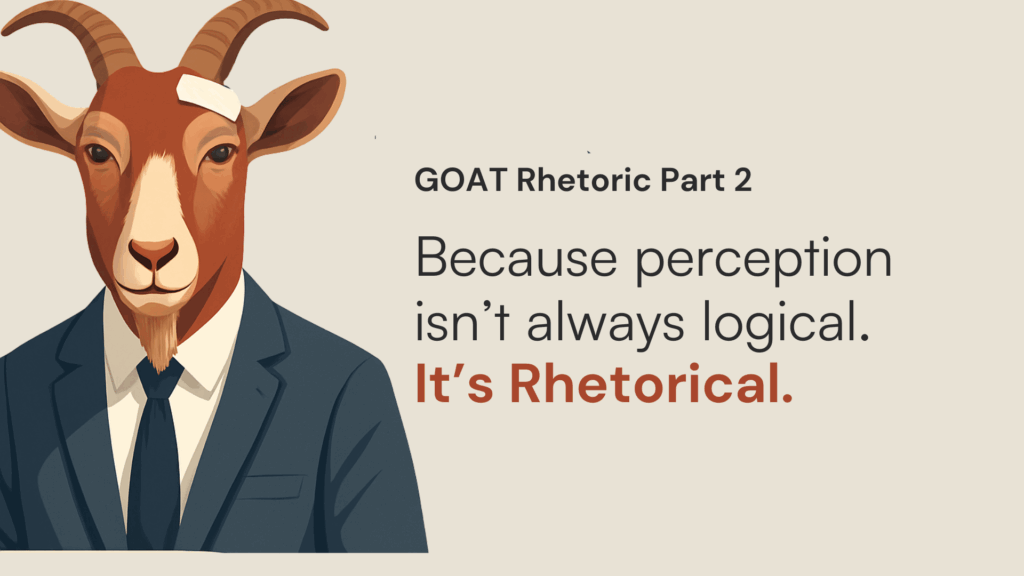
Why the Herd Stopped Following
In Part 1, we introduced GOAT Rhetoric and the story of Vinnie Van Goat. In Part 2, we unpack what happened next and what it means for your brand.
The Misinterpretation
After his injury, the world shifted for Vinnie. At one point, I recall my mom considered making him a rain hat—to keep water out of his exposed ear. Not to cover the wound, but to protect what had already been earned. But the real issue wasn’t physical.
It was rhetorical. Vinnie hadn’t changed. His signals had. And the herd misread them.
They didn’t see a survivor.
They saw a liability.
Not a scar but a flaw.
Not resilience but weakness.
So is a scar a flaw or is it a sign of strength? The answer? Well, it depends.
Scars are stories. Earned. Survived. Proof that something was faced head-on. Some say they’re just tattoos with better stories. But who knows the story? Who’s telling it?
When brand hiccups happen, whether it’s a stumble, a misstep, or a shift in leadership—what matters most is what happens next. Because if the fallout, the story, isn’t managed, the market decides the meaning.
A Day of Reckoning
Another year or two passed. The new hierarchy held. Claude led. Vinnie remained on the outside. Until one night—late, unremarkable, we came home and the goats didn’t greet us at the fence. No eager bleats. No movement in the pasture. Just complete silence.
By flashlight, we searched the field. And that’s when we found them: Blanche. Claude. Grover. It was clear what happened. Dog or coyote, it didn’t matter, they were gone.
And Vinnie? He wasn’t there. He was missing. In the dark, in the quiet, hope lingered.
The next morning, a neighbor called. Vinnie was in their yard. Alone, but yes, he was alive.
The Lesson
Our theory was simple: Vinnie did what only he could do. What we’d seen him do before. He’d already survived one dog attack. This time, when danger came again, he didn’t freeze. He leapt onto the Goat Pagoda and over the fence he went. He had the strength, the instincts and the memory of what it took to survive.
But the others? They could’ve followed. So why didn’t they? We can’t know for certain. But we do know this, they no longer saw him as strong.
The missing ear masked the truth. Vinnie wasn’t weak, but the herd believed he was. And in moments that demand action, belief decides everything—whether it’s accurate or not.
In the same way, brands that don’t actively manage perception surrender control. They let the story rewrite itself. A scar becomes a flaw. A moment becomes a message that misrepresents who they are. And even the strongest—if misread—can be left behind.
“Should you fail to pilot your own ship, don’t be surprised at what inappropriate port you find yourself docked.”
—Tom Robbins, Jitterbug Perfume
Perception isn’t passive, it’s a never-ending war. Your customers, buyers, board, team, and peers aren’t just watching. They’re interpreting, measuring what they see against what they believe. Every pause, pivot, or shift in posture, tone, or timing prompts a recalibration of their trust in your brand and their belief in your leadership.
When those signals stay misaligned too long, they begin to pull away. Quietly. Not because your product or service changed—but because their belief in it, or in you, did. They won’t bother to question it and they won’t warn you either. They just stop following.
That’s the danger of unmanaged perception: it doesn’t just distort your brand. It defines its fate. Even the strongest can lose the herd if they’re misread. Even the best product can fail if the market stops believing. Even a battle-tested survivor can be cast out because the signal changed.
When mis-signals go unnoticed or uncorrected, the damage doesn’t happen all at once. It builds quietly until momentum stalls, belief breaks, and your audience is already gone.
Common Brand Perception Gaps
Here are five common areas where perception slips that erode brand trust:
1. Visual Identity That Doesn’t Match the Moment
- A DIY logo on a $50M deck
- A rebrand that creates confusion instead of confidence
- Inconsistency across platforms, geographies and market touch points
Signal received: This brand isn’t keeping up.
2. Tone and Voice That Undermine Trust
- Channel-to-channel drift
- Humor that misses the mark, forgets the audience
- Sales messages that contradict the brand
Signal received: This brand doesn’t know who it is.
3. Internal Change That’s Not Narrated
- New hires, reorgs, pricing, or products but no story around it
- Silent pivots that look like stalling, or hiding
- Big moves buried in boilerplate
Signal received: Something’s going on and they’re not saying what. Must not be good.
4. Inconsistency Across Functions
- Premium promise, bargain-bin experience
- Slick pitch decks, clunky onboarding
- “Innovative” claims but legacy operations
Signal received: This brand says one thing and does another.
5. Lack of Momentum
- No fresh content
- No visible wins
- A quiet culture that looks like decline
Signal received: This brand has stalled.
Reflection Time
Ask yourself:
- Does our brand reflect who we’re becoming?
- Are we consistent in look, tone, and delivery?
- Are we letting our strongest traits go unnoticed or misinterpreted?
- Are we losing trust because we’ve gone quiet?
- Are we Vinnie? Strong enough to leap the fence, but no longer followed?